- cross-posted to:
- comicstrips@lemmy.world
- cross-posted to:
- comicstrips@lemmy.world
cross-posted from: https://lemmy.zip/post/9496590
You must log in or register to comment.
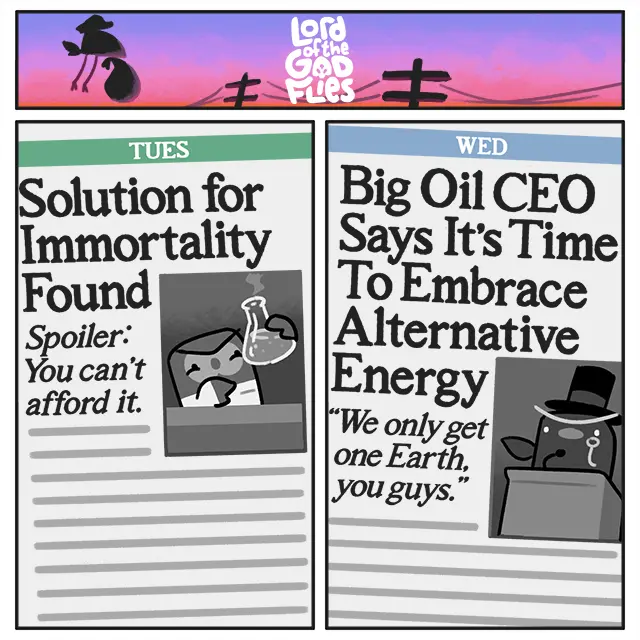
No one will be able to afford it. It won’t be for sale. Imagine the power of being the only source for functional immortality. It won’t be sold, it will be handed out in exchange for loyalty and service. “You’ll live for as long as I say you live. I’m not threatening you with death, life does that to all of us. I’m promising you life. I’m the good guy.”
Eventually, it will make its way out, but it won’t happen in our lifetimes.
I understand why you feel this way, but 1) it’s underway in our lifetimes (quite possibly) and b) it’s going to be cheap.
The first age reversing drugs can already be bought for a couple of thousands of dollars (dasatinib + quercetin (D+Q), an experimental senolytic combination, not very good because it’s the first, better cheaper will come).
Even if the cost is high for starters, governments would subsidise it (maybe not in the usa lol) to have healthier people, medic care for old decripit people cost enormously.
I know people love to hate on this subject, but it’s fantastic research that will help alleviate enormous sufferings, or so I think.
The way people cope with their silly little mortality is by holding on tight to the inevitability. Take that away and they panic, so they can’t think clearly about it.
Finally someone who understands :-)
Read HPMOR enough times and it eventually sticks.
You mean like renting it? Or a subscription?
There was a 2011 sci fi movie kinda about that. The movie wasn’t that good but it had some interesting ideas:
In 2169, people are genetically engineered to stop aging on their 25th birthday, when a one-year countdown on their forearm begins. When it reaches zero, the person “times out” and dies instantly. Time has thus become the universal fiat currency, transferred directly between people or stored on flashdrive type devices, some in secure bank vaults. Distinct socioeconomic caste “Time Zones” exist; Dayton is the poorest, a manufacturing hub and “ghetto” where people rarely have over 24 hours on their clocks, whereas in New Greenwich, the affluent Zone of plutocrats, people have enough time to be essentially immortal. … the people of New Greenwich hoard most of the time, while constantly increasing prices to impoverish people in less prosperous districts.
But it had Justin Timberlake!
He did an OK job. Mostly it was the script that let it down.
I really liked this movie ! A girl asked me to come watch it with her and I really liked that girl too
Thur: big oil ceo ousted, replaced with guy willing to focus on maximizing short term company performance
Yeah, its not the CEOs that ultimately make these decisions, theyre just the figurehead for the board. The board being the spokespeople for the shareholders.
Though, even if you replace the image on the right with one depicting a board of directors or a shareholder meeting, it wouldnt be accurate. Theyll do whats in their best interest and no further. Even if it fucks the rest of the world over.
The idea that “public companies only exist to maximize value for the shareholders” is toxic af, and only introduced because some famous economist made it popular [source needed, I have some vague recollection but I’m talking out of my ass]. Once it became the de facto law of capitalism, “investors” stopped allowing decisions that didn’t benefit their bottom line, and could sue to ensure decisions that they disagree with (especially if they cost more than they earn)
If we took away the “legal obligation to the shareholders”, which is an ultra-simplistic optimization that often results in “greedy algorithm” decision making for next quarters earnings, and made the obligation to 50% employees and 50% shareholders, along with better ongoing taxation of negative externalities, being on the board would be a real job instead of a few hours a week position in some cases. You’d have to negotiate big picture things, handle employee concerns seriously, while still being pushed to generate revenue by the shareholders.
Capitalism would probably still work, mostly. I think if leadership weren’t driven by “shareholder value”, adding plans to mitigate externalities that aren’t required by law would be easier. Currently, I don’t think any company builds a coal power plant with smoke or co2 capture that isn’t required to by law.
Stock markets would still be able to pick and choose investments, but if a company chose a 10 year plan that loses money the first year, they couldn’t be sued for replacement so long as the employees and one board member agreed on it.
Idk. It’s a poorly thought out fantasy of mine to fix how corporations work. I’m sure I’m missing something other than big piles of money that would never let it happen. There are a lot of other systemic legal and structural problems we’d need to fix, but reallocating boards to be 50% voting employee representatives would be a starting point.