

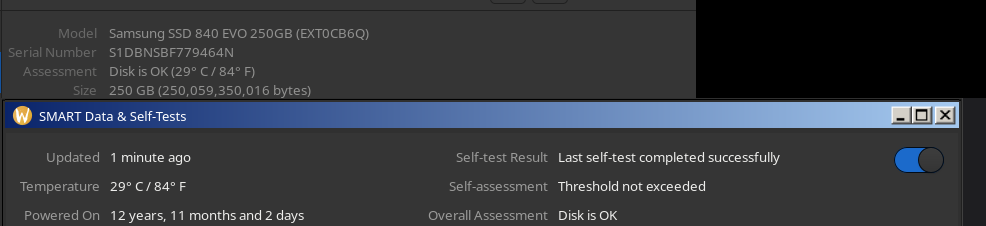
12 years and 11 months of powered-on time for this SSD… I should definitely turn it on for another month lol
10 years powered-on time for this HDD. Who says HDDs aren’t reliable? 😂
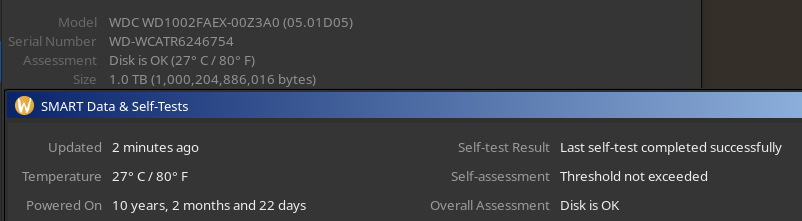
Anyone got better numbers than these?
No screenshots, but I had an old server with a pair of mirrored 8GB Seagates hosting a particularly specialized service on a very beefy and regularly maintained UPS and it had a server uptime of 21 years (had not been rebooted since somewhere around 1999) when I finally decommissioned it about 5 years ago, both disks would’ve been the same. It was on the public internet the whole time too, running Debian Slink with kernel 2.0.36, which had been awkwardly patched and rebuilt somehow to make the service (itself already obsolete at that time) actually work. I don’t know why I remember all this, but I do.
I do remember monitoring the SMART status at various points and the drive bearings must’ve been pretty cooked because those two drives were always running at 50-60C and I had a big old box fan pointed at the thing with the side panel off.
This example is also why I don’t always buy into the cult of “you must always regularly update all software immediately all the time”. Old software is not always bad software, same with old hardware. Sometimes it’s genuinely possible to have a bulletproof system. The problem is you never really know you do, until it either enters survivorship bias or becomes catastrophically proven otherwise. But you can make educated guesses, and if you’re going to naively assume that your old software must have exploitable security holes it seems equally naive to me to assume that updates must never have exploitable security holes. I think the risk calculus has to be done on a case-by-case basis.
I just hope you’ve got backups 🙂
Seriously though, we found an old Dell server at work that hadn’t been rebooted for years.
We knew that it was fine whilst it was running, but the stress of a reboot would finish it off with all those POST fan speed tests, RAID array tests, etc.
We took as much data off it that we thought might be relevant and rebooted it.
1 drive failed immediately. 1 fan must’ve had all the dust as that blew out a cloud during the fullspeed test.
A few days later more drives started failing and it just gradually died.
It was actually a sad day when we powered it off for the last time. 🥲
It was actually a sad day when we powered it off for the last time
No, it died not from the reboot.
It died because it’s life had no meaning anymore, after you had taken all the workload off it.
/s