
Kryptos is an end-to-end encryption app for iOS and Android that works through any messenger or SMS. You encrypt a message inside Kryptos (or on its keyboard), paste the resulting code into WhatsApp / Telegram / iMessage / Signal / VK / SMS / anything, and your correspondent decrypts it with Kryptos on their side. The messenger only ever carries what looks like random noise — the plaintext never touches it.
You must log in or register to comment.
“Repository layout” and emojis
Is it vibe-coded? Most AI projects have that layout.
Vibe coded with history obfuscated behind a million-line initial commit:
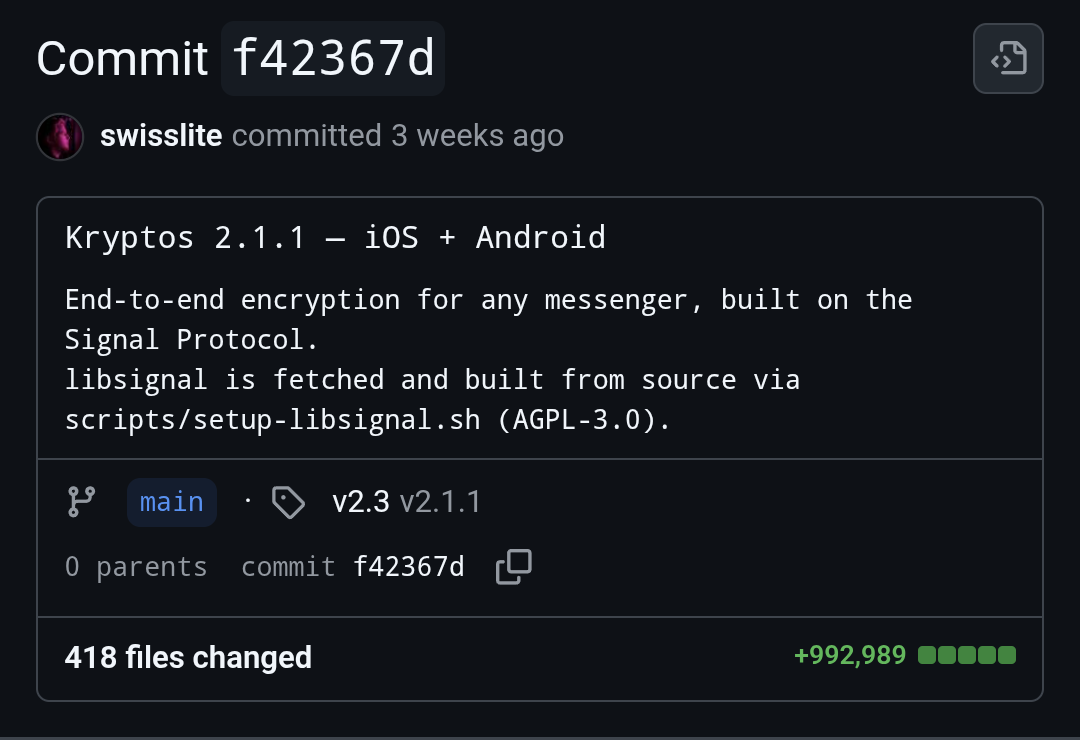
For anyone considering touching this intentionally-misleading radioactive garbage fire with a 10-foot pole:
You should never, ever use cryptographic or security tools that do not come from reliable, reputable sources.
Em dash, LLM trash. Not an absolute rule but it’s another red flag.
I love em dashes!!
This is just what signal does with extra steps… Even telegram private chats do this for you, and many other e2e-enabled apps. That’s exactly what e2e is when it’s implemented in an app, except you don’t have to copy-paste the encrypted data around yourself…
This seems more useful for someone’s secret notes or something than e2e chat.
I presume the idea is that by separating the encryption step from the messaging app, people can be more confident that government agencies are unable to monitor their conversations. You know, by taking secret screenshots of the device or whatever.
But it seems to me that you could easily do this yourself using the
gpgcommand line tool like so:gpg --encrypt --armor --recipient <PUBLIC KEY ID>This uses the stored public key identified by
--recipientto encrypt whatever you type and produce the result in ASCII text form, which can then be sent over whatever messenger you wish.I’d prefer to do it this way than trust some unknown 3rd party app.
You could even pipe the output into a tool such as
qrencodeto send your encrypted message as a QR code, depending on message length. This would allow you to keep the machine doing the encryption fully offline.Describing the extra steps does not magically make them not extra steps.
No thanks ,prefer reticulum network