Interestingly, it depends on how you measure efficiency.
Per unit of sunlight that hits a patch of land, solar panels capture about 20% of the sunlight that hits. Charging a vehicle battery and powering the motor might result in a 25% loss, so that we’re basically converting about 15% of the sunlight into movement.
In contrast, plants convert only about 1-2% of sunlight energy through photosynthesis. Feeding that plant biomass to be converted into stored energy in an animal, and then that animal moving its muscles to propel a vehicle, we might be talking a huge loss there, too, so that we’re looking at less than 1% of the sunlight being turned into motion.
If you want to most efficiently convert sunlight into movement, bypassing any and all biological processes is probably the most efficient thing to do.
There was a startup that made a splash last year by claiming they had a process that could manufacture organic compounds, including edible fats resembling animal-derived butter, out of nothing but carbon dioxide, water, and energy, through a Fischer-Tropsch process.
I could see a world where people on a spaceship more efficiently use their sunlight to create synthetic edible macronutrients rather than using that same sunlight to try to grow edible plants.
Yeah but plants just like magically appear, solar panels need raw materials, a factory and all the infrastructure that comes with that. Add that mess into your equations.
I feel - apple grows on a tree in my garden, I eat apple, I power bicycle is more efficient than - I mine raw materials, I build factory, I bring all raw materials to factory, I power factory and produce solar panels, I put solar panels in field, hook them up to the power grid, and then think about charging my ebike which also took way more raw materials than a bicycle due to lack of battery and I would still need to power myself.
What percentage of your calorie intake comes from industrialized agriculture, where planting, growing, and harvesting the food uses a significant amount of fossil fuels and fertilizers and other inputs that come from industrialized production?
Home grown and locally grown food is pretty good for flavor, but not particularly efficient with calories.

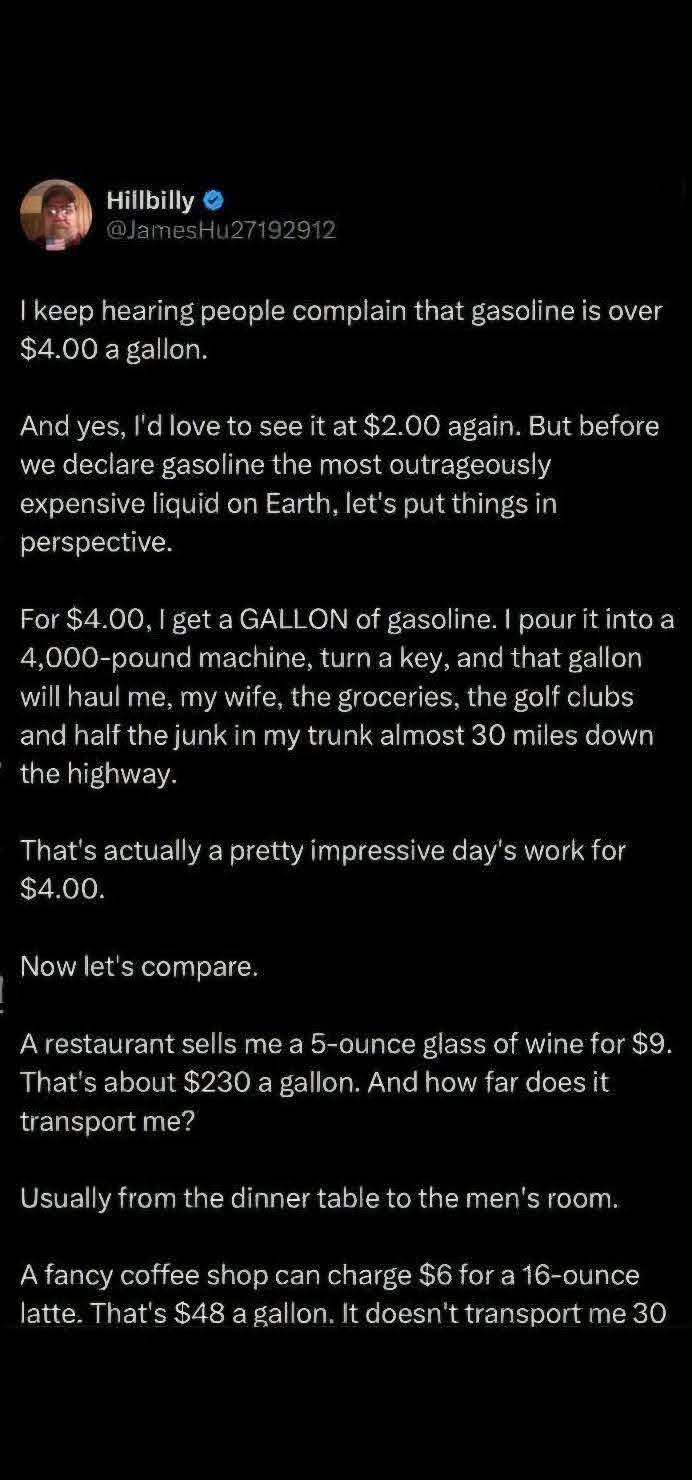
My bike gets like 100 miles per gallon of oatmeal
density of oatmeal (source (although this is with sugar)): 693 kg/m³ = 0.69 kg/L
nutritional value of oatmeal (source): 297 kJ/100g = 2970 kJ/kg
(oatmeal with sugar and stuff: 4600 kJ/kg, same source as the first one)
typical leisurely cycling energy expenditure (source): 80 kJ/km
bicycle oatmeal-efficiency: (2970 kJ/kg * 0.69 kg/L) / (80 kJ / km) ≈ 25.62 km/L ≈ 3.9 L/100km ≈ 60 mpg
bicycle oatmeal-efficiency with sugary oatmeal: (4600 kJ/kg * 0.69 kg/L) / (80 kJ/km) ≈ 39.68 km/L ≈ 2.5 L/100km ≈ 93 mpg
please do correct me if I’m wrong, but it looks like the math pretty much checks out on that one!
That can’t be good for the fuel injector.
You can brush your teeth if there’s a lot of sugar.
You need to mix it with something. Once you add water or milk its great. It usually gets stuck when you add it dry.
Just don’t put any additives or you will blow up the exhaust
Nothing beats bicycle when it’s comes to efficiency.
Interestingly, it depends on how you measure efficiency.
Per unit of sunlight that hits a patch of land, solar panels capture about 20% of the sunlight that hits. Charging a vehicle battery and powering the motor might result in a 25% loss, so that we’re basically converting about 15% of the sunlight into movement.
In contrast, plants convert only about 1-2% of sunlight energy through photosynthesis. Feeding that plant biomass to be converted into stored energy in an animal, and then that animal moving its muscles to propel a vehicle, we might be talking a huge loss there, too, so that we’re looking at less than 1% of the sunlight being turned into motion.
If you want to most efficiently convert sunlight into movement, bypassing any and all biological processes is probably the most efficient thing to do.
So I should start eating solar panels then?
There was a startup that made a splash last year by claiming they had a process that could manufacture organic compounds, including edible fats resembling animal-derived butter, out of nothing but carbon dioxide, water, and energy, through a Fischer-Tropsch process.
I could see a world where people on a spaceship more efficiently use their sunlight to create synthetic edible macronutrients rather than using that same sunlight to try to grow edible plants.
Yeah but plants just like magically appear, solar panels need raw materials, a factory and all the infrastructure that comes with that. Add that mess into your equations.
I feel - apple grows on a tree in my garden, I eat apple, I power bicycle is more efficient than - I mine raw materials, I build factory, I bring all raw materials to factory, I power factory and produce solar panels, I put solar panels in field, hook them up to the power grid, and then think about charging my ebike which also took way more raw materials than a bicycle due to lack of battery and I would still need to power myself.
What percentage of your calorie intake comes from industrialized agriculture, where planting, growing, and harvesting the food uses a significant amount of fossil fuels and fertilizers and other inputs that come from industrialized production?
Home grown and locally grown food is pretty good for flavor, but not particularly efficient with calories.
Similar with mine. 80km a week in cycling to work.
Herb grower eh. I use mine to get around town when Ive been uh… Growing herb…
Used to be a 20 buck can into town and 20 back. Saved hundreds on cabs, hundreds on fuel, got in better shape