

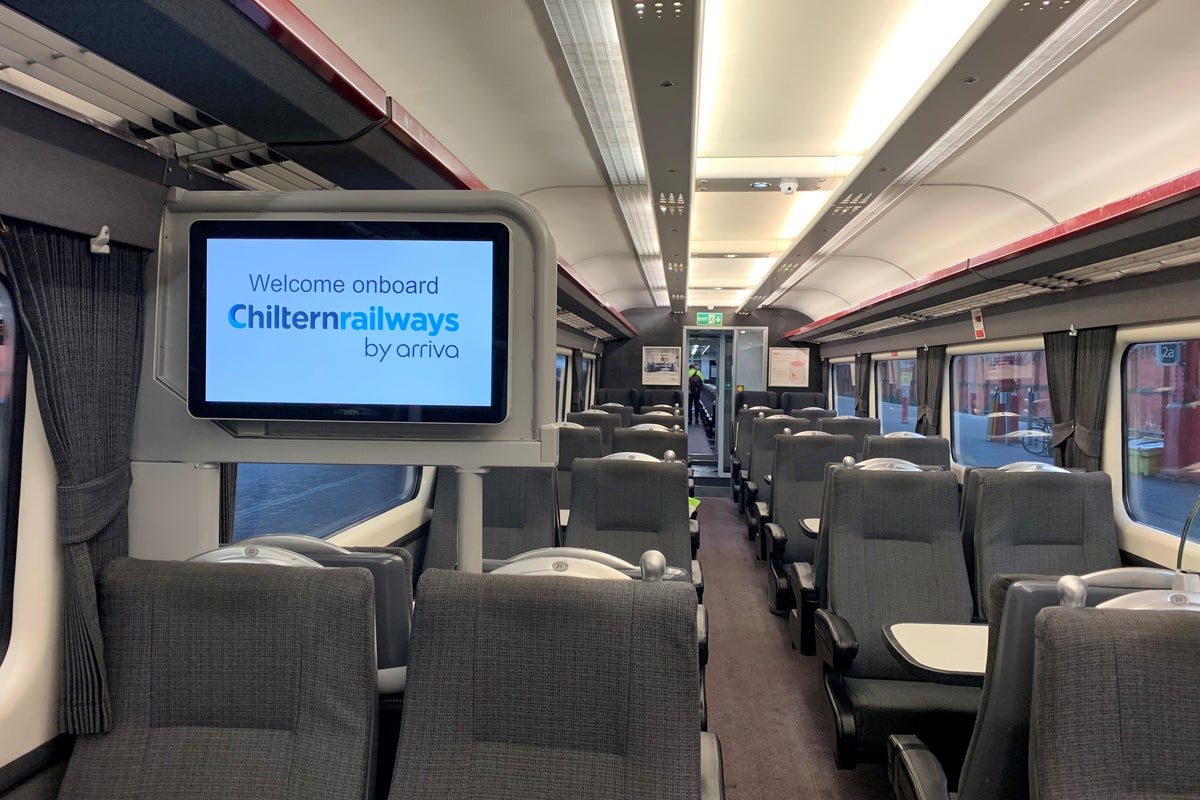
Chiltern Railways’ services became the latest to transition into public ownership on Sunday, marking the sixth train operator to be nationalised by the Government.
The UK’s largest train operator, Govia Thameslink Railway, alongside c2c, Greater Anglia, South Western Railway, and West Midlands Trains, have already been brought into public ownership by the Government.
From December, the Department for Transport (DfT) confirmed that 25 additional daily Chiltern Railways services will be introduced to help tackle “overcrowding”, delivering 10,000 extra seats during each weekday. This plan incorporates half-hourly weekday trains running along the Chiltern main line between London and Birmingham, as well as an increase in weekend journeys.
Ah yes, “those expressing ideologies other than mine don’t actually believe them”
You sure you commented in the right place? In the context of comment you replied to your comment makes no sense.
OP thinks that the actual goal of privatisation was not ideological, but grift. Nobody ever has any evidence for this kind of assertion - it’s always a combination of:
It’s so bizarre. Thatcher and her party were ideologues and all the evidence points that way. The whole position that enriching private investors was “the actual goal” is based on a lack of imagination around people holding different viewpoints.
In the case of privatisation in the UK, there was a long precedent with much ink spilled on the subject, but people like the OP discount it because they believe so strongly that anyone in power would be able to foresee the outcome, agree that the outcome was bad, and hence the only explanation was corruption.
I am not seeing any contradiction here. Yes they were ideologues. And the purpose of their ideology was exactly to enrich private investors.
No, their ideology was that state-run enterprises are less efficient than equivalent private ones, and that allowing and encouraging ordinary citizens to invest in those newly-private businesses (I’m not sure if this was done for the sale of the railways, but it was for previous privatisations) would enrich those ordinary citizens.
This was the defining economic debate of the late 20th century. Many people in these parts dismiss it out of hand.
I’m very glad that British railways are coming back into public ownership, yet somehow am able to acknowledge that in some respects privatisation was a success. The idea that the only, or the best explanation for privatisation was grift is unsustainable.
I dunno this seems like madness to me. Any private profit is, essentially, waste. Efficiency gains by, like, not supporting the entire public are also not real efficiency gains.
If a public service is running badly, the appropriate solution is to look into why, not let some rich people become richer off of it.
I don’t agree with it, but I don’t at all think it’s mad.
Typical profit margins at companies are under 10%. To me it seems perfectly plausible that changing the incentive structure around how a company is operated would have a way bigger impact than that. (There’s also executive pay which is higher in private companies, but is typically chump change compared to profit).
So you’ve got to put yourself in the shoes of someone who fervently believes that there is a lot of waste in the public sector. That is, despite decades of effort at trying to reduce or eliminate it. And, let’s get one thing out in the open: there is a lot of waste in the public sector. (It just so happens that there is also a lot of waste in the private sector, and generally less waste in the public sector than its detractors say) So if you believe that, chucking 10% profit at shareholders - who in the case of the big, trumpeted privatisations of the Thatcher years - were supposed to be ordinary citizens as shares in British Gas were heavily advertised to the public, and many bought them - seems like a potentially great deal. Not madness at all.
This was part of a major rethink not so much about “how to run individual public services” but “what is the role of the state, and what is it best placed to do?” It was felt that we’d already looked into why public services were running badly, and got to the end of the road.
And just to emphasise, the idea of privatisation was not “let some rich people become richer.” It was to sell shares in privatised companies to as many people as possible, and make investors out of all of us. In one way, it worked: millions of people bought shares in British Gas. But it didn’t end up sticking: most people who bought shares later sold them, making some decent money but yielding the longer-term benefits to bigger investors.
I feel confident one can change incentives and operational practices without privatizing.
Some people are delusional but I’m not sure the value of spending a lot of time in their shoes. In the US many people fervently believe the Republicans are “better at the economy” despite evidence pointing otherwise.
This seems like an inefficient way to share public wealth that gives advantage to the wealthy. Let’s say you’re correct and the value of the shares goes from 10 to 100. People who bought more shares profit more. People with more money on hand can buy more shares. It’s a large advantage to the wealthy.
As you said
So it sounds like we agree? Privatizing advantages the bigger, wealthier, investors.
What I disagreed with is that the belief was mad. You’ve just explained a lot of ways that the belief was wrong not that it was mad. We agree that it was wrong, so this didn’t do anything to convince me that it was mad, and I still don’t agree with that.
If I’ve understood this line of argument, you’re raising objections to privatisation, and then concluding “since privatisation is a bad idea, anyone who believes it’s a good idea must be mad.” Do correct me if this is not your logic.
If it is then it’s unsound in a way that I see repeated again and again on Lemmy: people who disagree with you on one thing tend to also disagree with you on other things. Specifically, someone who thinks privatisation is a good idea, does not (or did not) agree that any of the arguments you raised were sufficiently strong. It would be mad to continue to think that privatisation is a good idea if you agree with the arguments you made against it.
But merely disagreeing with your arguments is not mad. Just wrong.
“Somebody should make a profit off this because it’s more efficient” and “my cronies should make a profit off this because it helps me” are different, but the distinction is so minor in practice that lots of normal people rightfully don’t give a shit about it.
They are wholly different in desired outcome and motivation.
In the former, the motivation is a better service by allowing profit. In the latter, profit, and its direction to cronies, is the motivation.
People just often feel uncomfortable imagining their political opponents having good intentions.
I was in a hurry when I wrote the previous comment, but I would also like to point out that when something is both (a) a natural monopoly and (b) has a lot of positive externalities (e.g. public transport), it is the least appropriate candidate for privatization possible. If somebody wants to do it even despite that, it’s entirely justified to question their motives!
Questioning motives is always reasonable, but concluding that their motives are evil is not justified here (i.e. the answer to the question cannot reasonably be a conclusive “it’s evil”), because the claim that you are then making is ridiculous.
Serious economists who stand to gain little-to-nothing from espousing right-wing economic policy have pushed for privatisation for decades - opposed, of course, by many serious economists who espouse left-wing economic policy.
The “evil motivations” conclusion either has to accuse all those economists of being evil (for what gain, we do not know) or it has to claim that a person’s motivations for putting forward right-wing economic views is entirely inexplicably ceases to be “honest but misguided” and becomes “dishonest and self-serving” in perfect correlation with what they stand to gain. That’s not reasonable: if it’s possible for someone to honestly hold an opinion, the mere presence of them having something to gain from that opinion doesn’t turn it dishonest.
This is before we get to actually assessing whether politicians actually stood to gain much from privatisation. John Major, for example, who oversaw rail privatisation, was born to a middle class family that later fell on hard times. He wasn’t born with a silver spoon in his mouth and attending parties with bankers. That brief analysis can’t tell you everything about his motivations, but it should make it more realistic that his sympathies lie more with ordinary people than with the ultra-rich, even though he oversaw policies which we know, or at least believe and can argue for, hurt ordinary people.
You’re right, it’s a combination of both.
Not everyone is in on the grift, but they still need popular support so they convince the lowest common denominator that it’s good for them somehow.
I think privatisation now is a lot more likely to involve grift than privatisation then. Back then, theoretical arguments about privatisation held more weight, and people had not developed convincing yet acceptable ways to funnel money into private hands. Now we know that privatisation has caused a lot of problems, and a lot of people touting it have much closer links with people who stand to benefit.
My country privatized electricity suppliers almost 30 years ago (coincidentally the same time period the UK train companies got privatized… hmm…) with the argument that the choice of supplier would mean competition would drive down prices.
HAHAHAHA psyche. Prices have never climbed as fast as right after that move and they’ve never come back down (and never will).
OK?