Source: https://infosec.exchange/@0xabad1dea/117485038136053872
transcript
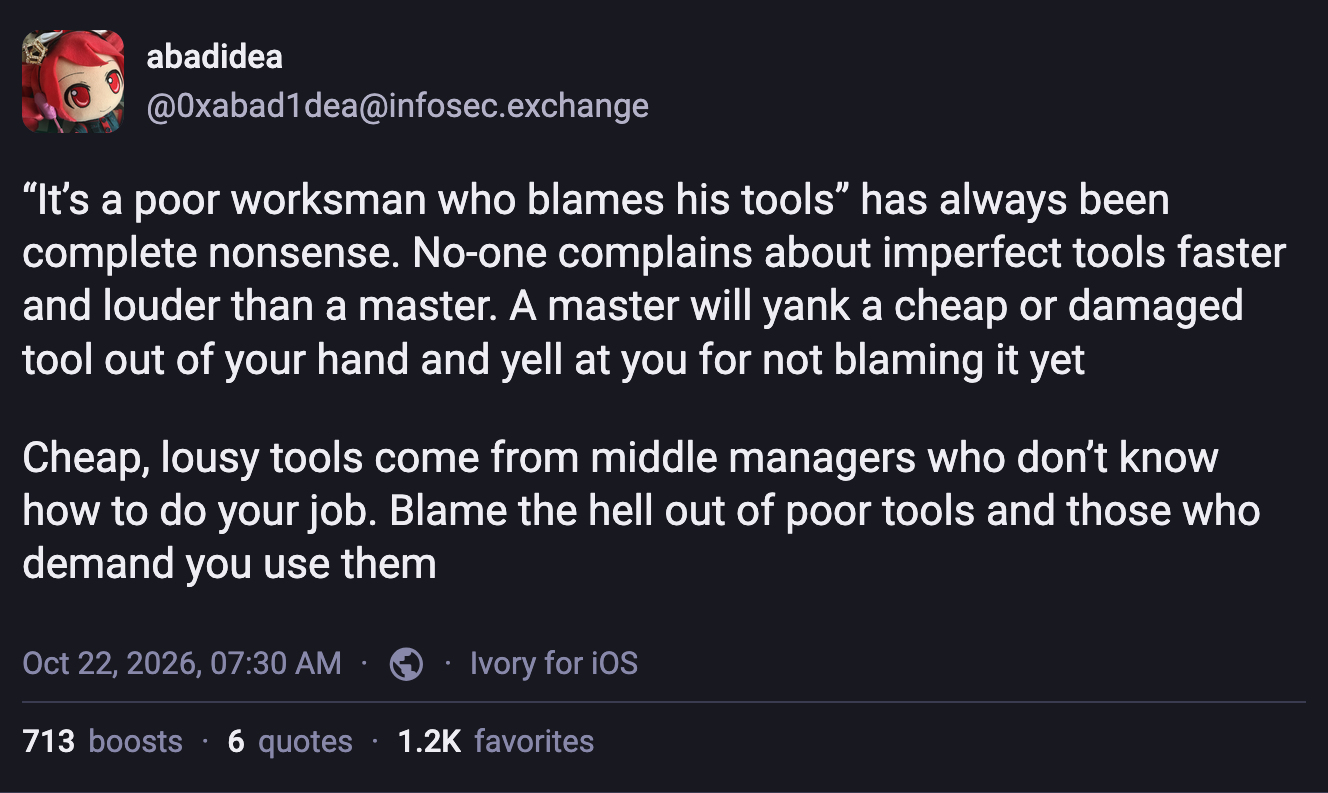
“It’s a poor worksman who blames his tools” has always been complete nonsense. No-one complains about imperfect tools faster and louder than a master. A master will yank a cheap or damaged tool out of your hand and yell at you for not blaming it yet
Cheap, lousy tools come from middle managers who don’t know how to do your job. Blame the hell out of poor tools and those who demand you use them
You must log in or register to comment.
It’s about responsibility. The master doesn’t blame a bad tool if they get a bad result. They blame themselves for using a bad tool. Or in some cases, the person or system that forces them to use a bad tool.
This totally misses the point of the phrase. A master won’t blame their tools, because they’ll still make a wonderful piece even with shoddy tools. They’ll complain about them though, which is distinct from blame.
An amateur doesn’t have the skills needed to make a masterpiece, even if they have the best tools. They won’t understand how to best make use of good tools, so they’re only going to help so much in their hands.
That’s the point of the phrase, but it may also be a product of an earlier time when tools were not as widely available and varied in quality. It may not mean the same thing today.
In a modern sense, a real master craftsman simply won’t work with cheap, shoddy tools unless necessary. They will invest in the thing that let’s them work. It’s a tax write off anyway, it’s worth the cost. You won’t catch a world-renowned carpenter at Harbor Freight buying the cheapest just from the discount bin.
If anything, while it means in one sense that a poor craftsman will blame shitty tools, because a good craftsman won’t suffer shitty tools in the first place.
I totally agree with you but have a snarky correction to the last part:
A Master Craftsman knows what makes more sense to buy at Harbor Freight. You’ll never catch them buying saw blades there but a 20-pack of paint pyramids for $5 gets the job done the same as a 4-pack for $10
It’s a poor craftsman who blames his tools. It’s a master who knows what tools are worth using.
Beginner level tasks can be done with mediocre tools, because they don’t require a ton of precision. That’s why they’re beginner tasks.
Master level tasks may require highly specialized and high quality tools. A master can tell when a tool isn’t up for the job of that very high level task, and often true expertise involves knowing how to maintain one’s tools to be able to do work with the required level of control or precision.
Understanding the scope of the critique is important. It’s still valid to criticize beginners who blame their tools when failing at very forgiving tasks that don’t require good tools.
Not for everything. Something small diy can look beginner like replacing something but actually it’s harder than expected because your cheap tool starts bending and it’s rusted out stuck more than you expected. But would be 3 second easy with a good tool.
I agree with this to a degree, but I think the idea is to imbue the idea that an expert with shoddy tools will be more effective than an amateur with the best tools.
And GAS (gear acquisition syndrome) is a thing a lot of beginners fall prey to. Nobody likes being bad at something, and manufacturers love to promise that their gimmick will make you good overnight.
I do photography as a hobby, and you absolutely do not need a $2000 camera to take good photos. Some of my favorite shots have been taken with my phone, despite owning a dslr.
I have an addiction to hobbies, and my technique for aquiring equipment for new hobbies is to get gear that is cheap and “hackable”, as in my experience that makes for the most learning opportunities at the lowest costs.
Absolutely, I often say that the only hobby I stick to is acquiring new hobbies. I got into 3d printing with a cheap Ender 3 that I proceeded to hack and fix until no original parts remained. I learned more about 3d printing than I ever would have buying a state of the art printer. I now have an expensive printer that I don’t need to maintain as much, mostly to support my other hobbies, but if something goes wrong I know how to fix it, and I know how to get the best results.
Musician here. My main instrument is guitar. I agree with this wholeheartedly.
Manufacturers have so much mythological bullshit in their copy. A lot of easy to add things that most beginners (or most people in general) do not need are plastered all over.
I have a nice rig with a (few actually, but one main) tube amp, custom guitar, nice pedalboard. It feels good, no doubt. No hate for the nice rig with all the things you’re supposed to love. They’re fun to play and sound amazing.
But my favorite rig is my duosonic rig. An early 90s practice guitar that’s been beat to shit, a boss overdrive, a cheap AiaB pedal, and a Palmer cab sim. That’s the whole rig. It’s technically my backup rig but I play it all the time.
A setup on pretty much any guitar that has a recognizable name and any recognizable name amp or modeler (if that’s what you’re into) will get you a sound that no one in any audience will be weird about and won’t be a nightmare to play.
Some of my favorite music is cheap, shitty gear or things that were called toys in their day. Some of the most famous music was made from that. Not all. But don’t let a company sell you on some shit because it’s shiny.
Another nice thing about cheap gear, is that it’s less intimidating. I had a friend once who wanted to get into guitar, so his folks bought him a real nice new acoustic guitar, and he was just too worried about breaking it to actually learn how to play. His buddy took him down to the thrift store, got him a $10 used Yamaha electric to learn on instead, and he was able to get over that particular hump.
Please do not take shots alcohol causes cancer and cirrhosis.
Shots shots shots shots shots
The master craftsman will use the shitty tools they have to make the good tools they need.
The master craftsman will know where they can wing it and by how much, and this includes shitty tools
That only works if you’re the kind of craftsman that makes tools. A carpenter probably isn’t making a good planer (at least not from raw materials)
It does depend on the field, but a lot of trades utilize tool making as an entry level educational opportunity to teach students basic skills. One of the first things I built in school for orthotics and prosthetic was a set of calipers used to measure the inside of a prosthetic socket. I still use the calipers and the skills used to create the calipers on a regular basis.
A carpenter who is incapable of making a planer is not a “master” carpenter. For the master, the decision to purchase a planer is a choice. The novice has no choice: he can only buy.
In order to be a master carpenter you need to be able to make metal tools? So a master carpenter must also be a master blacksmith?
That seems like a high, specific bar for mastery. I don’t think, to be considered a master filmmaker, someone has to be able to fashion their own camera (and film) from scratch. I think tool making is a whole separate set of skills from tool using, and someone could master one or the other without both.
I would say that you’re describing a “skilled” craftsman. The bar for “mastery” is extraordinarily high.
Huh. I interpreted it to mean: if you end up with a crappy result, it’s on you and not the tools. This leads you to think: should I focus on improving my skills? Or change the task? Or adjust expectations? etc.
Both interpretations seem perfectly valid
Good craftsmen don’t blame bad tools because they don’t use bad tools. They have learned the craft well enough to know what makes a good tool and will get that one and properly maintain it.
Also, good craftsmen could use bad tools if they really had to, and they’d still produce decent work out of it.
While a bad craftsman does shitty work and then blames the bad tools for it.
In the making of for RHCP’s Dani California, Flea complains about the crappy prop bass they gave him for one of the scenes. I saw that in high-school and will never forget it. I teach guitar and bass now and always remind beginners that their guitars need to be properly set up before they can even consider blaming themselves.
I have a set of Milwakee spanners I bought after having my work ute stolen.
They are a nightmare, a 24mm spanner is just under 24mm at the edge of the jaws and makes it hard to put on or off nuts and bolts.
I was going to buy another set of kingchrome spanners but they have changed the form to look more like snapons and I find them to sharp on the hand for pulling on all day.
I feel like that idiom implies “blame for poor results”. Because yeah, bad tools will slow you down, but if you’re a master, you’ll still make it work to get a high-quality result.
While true, it’s also true that a master craftsman can do more with a rock than a poor craftsman can do with a hardware store.
Well, the poor craftsman doesn’t have any money to buy tools from the hardware store
I blame the shareholders instead, everything has to constantly get cheaper to sustain growth, it’s unsustainable and frankly, idiotic. Capitalism.
I get what you’re saying… but middle managers are the poor tools!
Took me like 5 rereads to understand this for some reason lol. Anyone else found this one confusing?
Its my contention that even in a communist society, one that has reinvigorated the passion for craftsmanship, mechanics of all crafts will tinker with different tools.
The method of producing the end product could and should adapt to the need of the crafts person producing it. It’s what, in my opinion, makes the product human/ flawed/ authentic as a result.
I for one enjoy seeing imperfections in hand made products. It gives me insight into how the person crafting it may have held the object. Quite possibly indicating how their physical state was when producing it. Very human, I like that shit.
I for one enjoy seeing imperfections in hand made products.
Well then, brother, have I got some deals for you!